You’ve probably seen STFU pop up in texts, memes, comments, or chats and thought, “Wait… what does that actually mean?” You’re not alone.
The phrase is searched thousands of times because it shows up unexpectedly—and often with strong emotion.
The STFU meaning in text can range from joking sarcasm to outright rudeness, depending on who’s saying it and why.
In today’s fast-moving digital conversations, short slang like this spreads quickly, especially on social media platforms where tone is hard to read.
This guide breaks everything down in plain English: what STFU means, where it came from, how people use it today, and how you should react if someone sends it your way.
No confusion. No awkward moments. Just clarity.
What Does STFU Mean in Text & Chat?
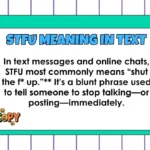
In text messages and online chats, STFU most commonly means “shut the f* up.”** It’s a blunt phrase used to tell someone to stop talking—or posting—immediately.
That said, context is everything. STFU can be:
- Aggressive → meant as an insult or command
- Playful → used jokingly between close friends
- Sarcastic → reacting to shocking or unbelievable news
Tone depends on:
- Relationship between speakers
- Platform (private chat vs public comment)
- Emojis or punctuation used
For example:
- “STFU 😭 no way that happened” → playful disbelief
- “STFU. Nobody asked.” → hostile and rude
Because it includes profanity, STFU is considered strong slang, not suitable for formal or professional communication.
Full Form, Stands For & Short Meaning of STFU
STFU is an acronym.
- Full form: Shut The F** Up*
- Short meaning: Stop talking / Be quiet
- Tone level: Strong to very strong
Important notes:
- The “F-word” makes it explicit
- Often censored as “shut the f up” or “stfu”
- Capital letters usually increase intensity
Quick breakdown:
- stfu → casual or joking
- STFU!!! → angry or aggressive
Even without caps, the meaning stays sharp.
Origin, History & First Known Use of STFU
STFU didn’t start online—it existed in spoken slang decades ago. The phrase became shortened as internet chat culture grew in the late 1990s and early 2000s.
Key milestones:
- Early use in online forums & IRC chats
- Popularized through gaming communities
- Spread via memes, YouTube comments, and Twitter
- Reinforced by texting culture where speed matters
The acronym survived because it’s:
- Short
- Emotionally powerful
- Instantly understood
Today, STFU is a staple of internet slang—recognized even by people who avoid profanity.
How People Use STFU in Daily Conversations
People use STFU in different emotional situations. Here’s how it usually appears:
Common usage styles
- Joking: among friends
- Reaction: to shocking gossip
- Argument: during heated debates
- Sarcasm: when someone is exaggerating
Quick examples
- “STFU 😂 that’s wild”
- “Bro stfu, you’re lying”
- “Can you stfu for one minute?”
Usage depends heavily on trust and familiarity. With strangers, it almost always sounds rude.
STFU Meaning Across WhatsApp, Instagram, TikTok & Snapchat
Each platform adds its own flavor to STFU.
- Used in private chats
- Often playful with emojis
- Can still cause fights if misunderstood
- Seen in comments or DMs
- Often sarcastic or mocking
- Can be reported if abusive
TikTok
- Used as reaction slang
- Usually means “no way!”
- Often not meant literally
Snapchat
- Casual slang between friends
- Emojis soften the tone
- Screenshots can escalate drama
Platform + tone = meaning.
Different Meanings of STFU in Other Fields
Outside casual texting, STFU rarely changes meaning—but perception does.
- Gaming: trash talk or jokes
- Pop culture: meme reaction
- Professional spaces: inappropriate
- Education: considered offensive
There’s no official “clean” definition in formal fields. It stays slang.
Common Confusions, Mistakes & Wrong Interpretations
People often misunderstand STFU because:
- They miss the joke
- They ignore emojis
- They don’t know the sender well
Common mistakes:
- Taking a joke personally
- Using it with elders or coworkers
- Posting it publicly without context
Rule of thumb: If you wouldn’t say it out loud, don’t text it.
Similar Terms, Alternatives & Related Slang
If STFU feels too harsh, here are softer or playful alternatives:
- “Be quiet 😂”
- “Chill”
- “Stoppp”
- “No way”
- “I’m done 💀”
Related slang:
- GTFO
- WTF
- SMH
- IDC
👉 Internal linking idea: link to pages like “WTF meaning in text” or “GTFO slang explained.”
Examples of STFU in Real Chat Situations
- “STFU 😭 I can’t believe that”
- “Nah stfu you didn’t”
- “STFU that plot twist was nonsensical”
- “Can you stfu? I’m busy.”
Emoji = tone softener.
How to Reply When Someone Says STFU
Your reply depends on intent.
If playful:
- “😂 never”
- “LMAO okay okay”
- “You love it”
If rude:
- “No need to be disrespectful.”
- “Let’s keep it chill.”
- Don’t reply at all
Silence is sometimes the best response.
Is STFU Still Popular? Trends & Online Usage
Yes—STFU is still widely used.
Why it survives:
- Meme culture keeps it alive
- Short-form video reactions
- Fast, emotional expression
However:
- Younger users prefer less aggressive slang
- Emojis often replace harsh words
It’s popular—but evolving.
FAQs
1. Is STFU always rude?
No. With friends, it can be playful.
2. Can STFU mean “no way”?
Yes, especially in reaction slang.
3. Is STFU appropriate at work?
Absolutely not.
4. What’s a nicer alternative to STFU?
Try “stoppp” or “be quiet 😂”.
5. Why do people use STFU so much online?
It’s short, emotional, and meme-friendly.
Conclusion
The STFU meaning in text isn’t one-size-fits-all. At its core, it stands for “shut the f** up,”* but tone, context, emojis, and relationships completely change how it feels.
Among friends, it can be funny or dramatic. With strangers, it’s often rude.
Understanding slang like STFU helps you avoid awkward moments, online fights, or accidental disrespect.
The internet moves fast, but a little awareness goes a long way. Before using it—or reacting to it—pause, read the room, and decide whether humor or silence is the smarter move.