If you’ve seen “TTS” pop up in a text message, comment, or DM and thought, “Wait… what does that mean?”—you’re not alone.
The TTS meaning in text is searched thousands of times because this short abbreviation can mean different things depending on context, platform, and tone.
In casual chats, gaming messages, or social media posts, TTS usually carries a quick, conversational meaning.
But in tech, education, and accessibility spaces, it stands for something more technical. That’s why people often get confused—and why you’re here.
In this guide, we’ll break down exactly what TTS means in text, where it came from, how people actually use it today, and how to respond when someone sends it to you.
No fluff, no copying—just clear, friendly explanations with real chat examples. Let’s decode it. 💬
What Does TTS Mean in Text & Chat?
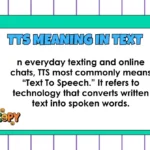
In everyday texting and online chats, TTS most commonly means “Text To Speech.” It refers to technology that converts written text into spoken words. However, depending on the conversation, it can also have casual or slang-based meanings.
When someone uses TTS in a chat, they might be:
- Talking about a voice feature reading messages out loud
- Referring to accessibility tools
- Mentioning robotic or AI-style voices
- Joking about something sounding “computer-like”
In fast conversations, especially in gaming, Discord, or TikTok comments, people often shorten everything. That’s why TTS appears without explanation, assuming others already know the meaning.
Context matters a lot here. A message like “Use TTS” means something very different from “That voice sounds TTS 😂”. One is functional, the other is descriptive or humorous.
So, while Text To Speech is the core meaning, how it’s used depends on where—and how—you see it.
Full Form, Stands For & Short Meaning of TTS
TTS stands for:
- Text To Speech
Short meaning in text:
- Turning written text into spoken audio using software or AI
In simple terms, TTS lets a device read text out loud. Phones, apps, games, and social platforms all use it in different ways.
Quick breakdown:
- T → Text
- T → To
- S → Speech
People shorten it to TTS because it’s faster and widely understood online—especially among tech users, gamers, and content creators.
You may also see it used as a noun or adjective, like:
- “That’s a TTS voice”
- “I used TTS for the video”
Short, efficient, and flexible—that’s why it stuck.
Origin, History & First Known Use of TTS
The concept behind TTS is older than social media. Text To Speech technology dates back to the mid-20th century, when early computers began experimenting with synthetic voices.
Key milestones:
- 1950s–60s: Early speech synthesis experiments
- 1980s–90s: Screen readers and accessibility tools adopt TTS
- 2010s: Smartphones and AI assistants make TTS mainstream
- 2020s: TikTok, YouTube, and gaming culture popularize “TTS voices”
The abbreviation “TTS” became common once online communities needed a quick way to reference the feature—especially in tech forums and gaming chats.
Social media then gave it a second life, turning TTS from a technical term into everyday slang.
How People Use TTS in Daily Conversations
In real life, TTS shows up more than you think—especially in digital spaces.
Common daily uses:
- Reading messages while driving
- Helping visually impaired users
- Creating voiceovers for videos
- Making jokes about robotic voices
In casual chats, people often use it informally:
- To describe how something sounds
- To reference AI or automation
- To tease content creators
Examples:
- “I turned on TTS because my eyes are tired.”
- “That sounds like pure TTS 🤖”
It’s practical—but also part of internet humor now.
TTS Meaning Across WhatsApp, Instagram, TikTok & Snapchat
While the core meaning stays the same, platform culture changes how TTS is used.
- WhatsApp:
Usually literal—voice reading messages aloud. - Instagram:
Refers to AI voiceovers in reels or stories. - TikTok:
Extremely common. “TTS voice” often means the default robotic narration. - Snapchat:
Used playfully for filters or automated voices.
Example:
- “Why does every TikTok use the same TTS voice 😂”
Same letters—different vibes.
Different Meanings of TTS in Other Fields
Outside texting, TTS can mean different things depending on the field:
- Technology: Text To Speech systems
- Gaming: Donation messages read aloud via TTS
- Education: Learning support tools
- Business: Automated voice systems
That’s why it’s important not to assume tone or intent without context.
Common Confusions, Mistakes & Wrong Interpretations
People often misunderstand TTS because:
- They assume it’s slang only
- They confuse it with unrelated abbreviations
- They miss the platform context
Common mistakes:
- Thinking it’s an emotion or reaction
- Assuming it means “talk to someone”
- Reading it as sarcasm when it’s technical
When unsure, ask—or look at the sentence around it.
Similar Terms, Alternatives & Related Slang
Related terms you might see:
- AI voice
- Robot voice
- Voice bot
- Speech synthesis
- Auto voice
Internal linking suggestions:
- Link to pages on “AI meaning in text”
- Link to “SMH meaning in chat”
- Link to “IMO meaning in text”
These help readers explore related slang naturally.
Examples of TTS in Real Chat Situations
Quick, real-style examples:
- “I use TTS when I’m multitasking.”
- “That narration is straight TTS 🤖”
- “Turn on TTS, my hands are busy.”
- “Why does this sound like a TTS bot 😂”
Short, casual, and context-driven.
How to Reply When Someone Says TTS
Your reply depends on tone:
- Curious:
“You mean text to speech?” - Casual:
“Yeah, that TTS voice is everywhere 😂” - Technical:
“TTS helps a lot with accessibility.”
Matching the vibe keeps conversations smooth.
Is TTS Still Popular? Trends & Online Usage
Yes—TTS is more popular than ever.
Why?
- AI content is booming
- Short-form videos rely on fast narration
- Accessibility tools are expanding
TTS has moved from background tech to front-and-center internet culture.
FAQs
1. What does TTS mean in texting?
It usually means Text To Speech, where text is read aloud.
2. Is TTS slang or technical?
Both. It started technical but is now common slang.
3. What does TTS mean on TikTok?
It refers to the AI voice narrating videos.
4. Can TTS mean different things?
Yes, depending on context and platform.
5. Is TTS still used today?
Absolutely—it’s growing with AI and social media.
Conclusion
The TTS meaning in text may look simple, but it carries layers of meaning shaped by technology, culture, and platform trends.
At its core, TTS stands for Text To Speech, yet how people use it ranges from practical accessibility tools to playful internet slang.
Understanding the context—where you see it and how it’s used—makes all the difference.
As AI voices, automation, and digital communication continue to grow, TTS isn’t fading anytime soon.
In fact, it’s becoming part of everyday language online.
Now that you know what it means, how it’s used, and how to reply, you can read those messages with confidence—and maybe even use TTS yourself. 😉