Last updated on April 22nd, 2026 at 05:49 am
If you’ve ever been texting someone online or scrolling through social media, you might have come across the term “ASL”. But what does ASL mean in text?
🤔 Many people, especially those new to internet slang or online chatting, often wonder why someone would randomly ask for ASL.
Is it a secret code, a greeting, or something else entirely?
ASL is a short, simple abbreviation that has been around for decades in the world of online messaging.
It’s commonly used in chats, forums, dating apps, and social media platforms like Instagram, WhatsApp, TikTok, and Snapchat.
Understanding ASL is not just about decoding letters—it’s about knowing how people communicate quickly online.
In this guide, we’ll break down everything about ASL: its meaning, history, usage, and even examples of how to reply when someone asks it.
What Does ASL Mean in Text & Chat?
In text and chat, ASL typically stands for:
A = Age, S = Sex, L = Location
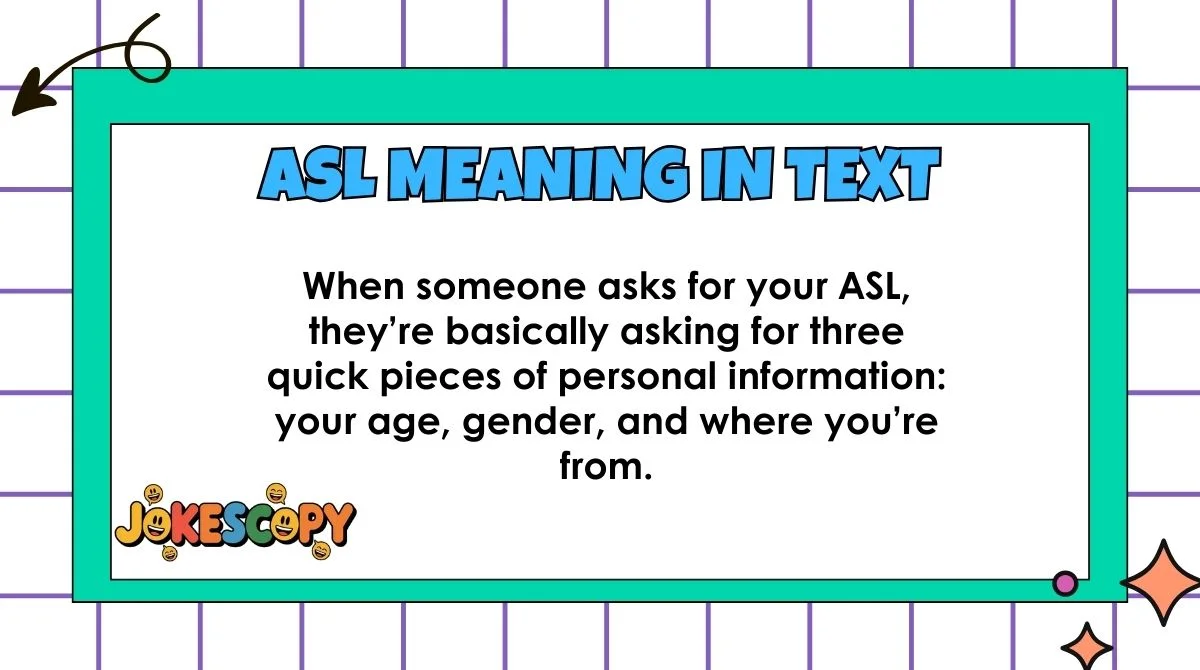
When someone asks for your ASL, they’re basically asking for three quick pieces of personal information: your age, gender, and where you’re from.
- Example in chat:
- Friend: “Hey! ASL?”
- You: “23/F/Chicago 😊”
Originally, ASL was a common way to start conversations in chat rooms, especially on platforms like AOL Instant Messenger (AIM) and early internet forums. It was a fast way for strangers to get to know each other without exchanging long messages.
📌 Quick Tip: While ASL is harmless in casual chats, be cautious when sharing personal info with strangers online.
Full Form, Stands For & Short Meaning of ASL
- Full Form: Age, Sex, Location
- Short Meaning: Asking someone about their basic personal info
- Purpose: Initiate conversation quickly in online chats or social apps
💡 Alternative interpretation: While rare, in some contexts ASL can also refer to American Sign Language, but in texting, it almost always refers to Age, Sex, Location.
What does “ASL” mean in movies?
In movies, “ASL” most commonly refers to American Sign Language, a visual language used by the Deaf and hard-of-hearing community. When you see ASL in films, it usually means characters are communicating through hand signs, facial expressions, and body movements instead of spoken words.
Many modern movies include ASL to improve representation and accessibility, sometimes featuring Deaf actors or interpreters. Subtitles are often used alongside it so all viewers can follow the dialogue.
In some older or casual contexts, “ASL” might also be recognized as “age, sex, location,” a phrase from early internet chat culture, but in films, it almost always refers to the sign language used for communication and storytelling.
Origin, History & First Known Use of ASL
The abbreviation ASL originated in the 1990s during the rise of online chat rooms and instant messaging. Platforms like AOL, ICQ, and early MSN Messenger popularized quick typing shortcuts to save time and make chatting faster.
- First widely used in AOL chatrooms in the mid-1990s
- Became a standard icebreaker among teens and young adults
- Popularized as shorthand in forums, dating chats, and later on social media
ASL’s use has declined somewhat with the rise of smartphones and social media platforms where profiles already display age, gender, and location. However, it’s still recognized in some chat communities.
How People Use ASL in Daily Conversations
People use ASL mainly to start casual conversations online. It’s simple, fast, and helps determine compatibility or context in group chats or dating conversations.
- Chatroom example:
- Stranger: “Hi, ASL?”
- You: “19/M/NYC 😎”
- Social app example:
- Instagram DM: “ASL?”
- Response: “21/F/LA 🌴”
It’s also sometimes used jokingly among friends who already know each other, just as a playful nod to old-school internet slang.
ASL Meaning Across WhatsApp, Instagram, TikTok & Snapchat
Although ASL originated in text chats, it appears frequently on modern platforms:
- WhatsApp: Quick icebreaker with new contacts
- Instagram: Often in DMs, especially in casual or dating conversations
- TikTok: Rare, but seen in comments when asking personal info for trends or challenges
- Snapchat: Commonly used in private chats and group conversations
💡 Pro Tip: Context matters—if you’re in a professional chat or public comment section, responding to ASL may not be appropriate.
Different Meanings of ASL in Other Fields
While in texting ASL almost always means Age, Sex, Location, in other contexts it can stand for:
- American Sign Language – the widely recognized language for deaf and partially -of-hearing people
- Above Sea Level – in geography or weather reports
- Advanced Squad Leader – in gaming communities
📌 Tip: Always consider context to avoid confusion.
Common Confusions, Mistakes & Wrong Interpretations
- Mixing ASL with American Sign Language – Common among beginners
- Thinking it’s slang for a greeting – It’s actually a question
- Sharing info with strangers – Never overshare your location or personal info online
Quick Reminder: Only share ASL details with trusted contacts.
Similar Terms, Alternatives & Related Slang
- HMU – Hit Me Up (invite someone to chat)
- IRL – In Real Life
- DM me – Direct Message me
- Age? Gender? City? – Plain English alternative to ASL
Examples of ASL in Real Chat Situations
- Example 1:
- Person: “ASL?”
- Reply: “25/F/Chicago 🏙️”
- Example 2:
- Person: “Hey, ASL?”
- Reply (jokingly): “29/M/Mars 👽”
- Example 3:
- Group chat: “ASL?”
- Reply: “22/F/NYC 😎”
How to Reply When Someone Says ASL
- Keep it short & safe:
23/F/LA 😊 - Use humor or creativity if chatting with friends
- Politely decline if you don’t want to share personal info:
- “I prefer not to share that 😅”
- Remember context is key – only respond if comfortable
What does “ASL” mean in medical terms?
In medical terms, “ASL” can have multiple meanings depending on the context, but one common definition is “arterial spin labeling.” This is a noninvasive imaging technique used in MRI scans to measure blood flow, especially in the brain.
It helps doctors assess conditions like stroke, tumors, or other neurological issues without using contrast dyes. In some healthcare settings, “ASL” can also refer to “advanced support life” or be used informally for “age, sex, location” in patient documentation, though this is less standard.
Because medical abbreviations often vary by specialty and region, it’s important to understand the context in which “ASL” is used to determine its exact meaning accurately.
Is ASL Still Popular? Trends & Online Usage
ASL is less common today than in the early 2000s, thanks to:
- Social media profiles displaying age and location
- Dating apps requiring personal info in sign-up forms
- Changing internet slang trends
However, it still pops up in nostalgic chatrooms, online games, and messaging among teens. Some older internet users even enjoy using it for fun or retro-style chatting.
FAQs
1. What does ASL mean in text chat?
ASL stands for Age, Sex, Location and is used to ask about someone’s basic info.
2. Is it safe to give your ASL online?
Only share with trusted contacts; avoid giving exact location to strangers.
3. Can ASL mean American Sign Language?
Yes, but in texting, ASL almost always refers to Age, Sex, Location.
4. Where did ASL originate?
It became popular in the 1990s in AOL chatrooms and early internet forums.
5. Are people still using ASL today?
It’s less common now, but still appears in casual chats, gaming communities, and among nostalgic users.
Internal Linking Suggestions
- Common Internet Slang Terms You Should Know
- Text Abbreviations for Chat & Messaging
- American Sign Language Basics
Conclusion
ASL is a simple yet iconic piece of internet slang that has survived decades of online chatting. While it originally helped strangers connect quickly in chatrooms, its meaning remains clear: Age, Sex, Location.
Understanding ASL is useful for anyone navigating texting, social media, or online gaming.
Though its popularity has declined with modern platforms automatically showing personal info, ASL still pops up occasionally, often as a playful nod to classic internet culture.
Knowing how to respond safely and appropriately ensures you can join in on conversations without oversharing.
So next time someone types “ASL?” in your chat, you’ll know exactly what they mean—and how to reply confidently, whether seriously or with a touch of humor 😄.